Join us for a FREE training session on “Risk-based-Thinking in ISO 9001” on Oct 28, 2020 | 5:30 PM – 8:00 PM EST. Visit our News & Events page to Register!

Author - gcertiadmin

ISO-9001-certification

Why Is ISO Certification Important?

ISO certification, also known as the International Standards Organization certification, is the validation of standard protocols met by a company. These standards are set by this particular organization, which ensures the safety of the products manufactured by the companies. This certification is internationally recognized. Any company found with this particular stamp on their products is always reliable, genuine, and trustworthy compared to the one that doesn’t have it. Any organization, regardless of its type, size, products, and services can get ISO 9001 certification.

Types of ISO certification

The company offers different kinds of certifications to manufacturing companies. Each of these kinds offers a different interpretation. The most significant one, however, is the ISO 9001 certification. 

ISO 9001 certification and its importance

This particular certification upholds that the organization possessing it can offer products as well as services that follow all regulatory requirements. Internal audit and gap analysis being a regular concept for such a company ensure better outcomes. ISO 9001 certification ensures a higher level of performance by the employees, a clear explanation of the quality control process utilized by the company as well as the reduction of the waste material. At the same time, a company with this certification improves efficiency with every passing day.   

Training and learning

A lot of people associated with the world of manufacturing products or offering services are interested in getting trained in ISO certification. The ISO training Canada offers a great opportunity to the people to learn the ISO 9001 standards. These learning techniques provide a great understanding of the minute details of this certification. The training includes workshops, classroom teachings as well as online sessions. As the classes are highly interactive, they offer a great opportunity to understand everything clearly.   

Significance for the auditors

These sessions of training are not only limited to those associated with the manufacturing processes. Rather, auditors also have the opportunity to get a hands-on learning process and a chance to polish their skills. ISO 9001 Auditors Training enables the auditors to conduct faultless audits in the organizations for which the certification inspection is required. The reports on the quality management system that the auditors produce after their training are always thoroughly professional. 

Consultants for everyone

If you are someone who is desperately looking for recommendations related to ISO 9001 Consultants near me, you are on the right track. No matter if you are attached to a company performing manufacturing activities or you are an auditor looking forward to polishing your skills, it is high time you get yourself enrolled in the right training program. This program will not only offer you minuscule details regarding the certification but will also give you real-time scenarios to put your knowledge into practice. Right from describing the certificate to identifying its terms, from giving a rundown of the requirements to demonstrating the actions, the training does it all.  

Conclusion

ISO certification surely sets a company following its rules apart from others. The manufacturing and service organizations that hold ISO certification are always much more reliable and mostly the first choice for the customers. Any company following the ISO certification rules will automatically be better in quality than the one that doesn’t hold such a certificate.   

Read more...
ISO-22301

MINIMUM DOCUMENTED INFORMATION FOR ISO 22301:2019

An Overview of ISO 22301:2019

ISO 22301 is an international standard that specifies the requirements to establish, implement, maintain and continually improve a Business Continuity Management System (BCMS) to protect against, reduce the likelihood of the occurrence of, prepare for, respond to and recover from disruptions when they arise.

The purpose of a BCMS is to prepare for, provide and maintain controls and capabilities for managing an organization’s overall ability to continue to operate during disruptions.

What is Documented Information?

The “documented information” is defined as the information required to be controlled and maintained by an organization and the medium on which it is contained. The example of documented information can be a record, specification, procedure, drawing, report, standard, etc.

The term “document” is defined as information created in order for the organization to operate e.g. procedures, instructions, specifications, guidelines, and criteria, etc. The term “record” is defined as a document that provides evidence of results achieved or activities performed e.g. evidence of training, operational control, corrective action, internal audit, and management review activities, etc. A set of documented information, for example, specifications and records, is frequently called “documentation”.

ISO 22301:2019 uses the standardized term “documented information” to refer to both documents and records. ISO 22301 uses the term “retain documented information” to describe a record (e.g. retain the results of corrective actions) and “maintain documented information” to describe a document (e.g. maintain the scope of Business Continuity Management System). The document is live information and needs to be updated as required while a record is a history of an event, activity, or action.

Clause 7.5 of ISO 22301:2019 describes the requirements of the documented information. Documented information can be in any format and media and from any source. The medium can be paper, magnetic, electronic, or optical computer disc, photograph or master sample, or combination thereof.

What is the minimum documented information required by ISO 22301:2019?

Every organization has to produce the minimum documented information required by ISO 22301 standard to demonstrate the conformance to the standard requirements. All the requirements of minimum documented information listed below might not be applicable to every organization depending on its operations and activities and shall be listed as an exclusion in the scope statement of the Business Continuity Management System (BCMS).

How to determine the requirement for ISO 22301 Documentation?

Clause 7.5 of ISO 22301 describes the requirements for documented information. To demonstrate the conformance to the requirements of ISO 22301, an organization may need to produce more documents and records than the minimum required by the standard because according to Clause 7.5, the organization’s Business Continuity Management System (BCMS) shall include:

  1. documented information required by ISO 22301 (as listed above)
  2. documented information determined by the organization as being necessary for the effectiveness of the Business Continuity Management System (BCMS) e.g. policies, procedures, instructions, guidelines, and relevant records other than the minimum required. It is quite common that for an effective Business Continuity Management System (BCMS), organizations establish procedures for hazard identification, risk assessment, compliance obligations, corrective actions, control of documented information and operational control, etc.

The extent of documented information for ISO 22301 may differ from one organization to another due to:

  • the size of the organization and its type of activities, processes, products, and services
  • the complexity of processes and their interactions
  • the competence of persons

The rule of thumb for an organization is to use a risk-based approach to determine the requirement for documented information other than the minimum documented information e.g. an organization may decide that due to lack of documented procedures and work instructions, there might be a risk to business continuity. The organizations also establish procedures and other documented information to establish controls as a result of a risk assessment or to address a nonconformity.

G-Certi provides ISO registration/certification services in Canada and 50 other countries for a number of ISO Standards including but limited to ISO 9001, ISO 14001, ISO 22301, ISO 22301, and ISO 22301, etc. The auditors of G-Certi ensure that your organization is conforming to the requirements of ISO 22301. Please feel free to visit gcerti.ca and contact one of our representatives for a complimentary pre-assessment to ensure that your organization is ready for ISO 22301 registration/certification.


Read more...
ISO-9001

MINIMUM DOCUMENTED INFORMATION FOR ISO 9001:2015

An Overview of ISO 9001:2015

ISO 9001 is an international standard that specifies the requirements to establish, implement, maintain and continually improve a Quality Management System (QMS). Organizations implement the ISO 9001 to demonstrate their ability to consistently provide products and services that meet and exceed customer requirements. ISO 9001 is the world’s leading quality management standard and has been implemented by over one million organizations in more than 170 countries.

Any organization, regardless of its type, size, products, and services can implement ISO 9001 to meet the quality requirements of its customers and other interested parties.

What is Documented Information?

As per ISO 9000:2015 (QMS – Fundamentals and Vocabulary), the “documented information” is defined as the information required to be controlled and maintained by an organization and the medium on which it is contained. The example of documented information can be a record, specification, procedure, drawing, report, standard, etc.

The term “document” is defined as information created in order for the organization to operate e.g. procedures, instructions, specifications, guidelines, and criteria, etc. The term “record” is defined as a document that provides evidence of results achieved or activities performed e.g. evidence of training, calibration, corrective action, internal audit, traceability and management review activities, etc. A set of documented information, for example, specifications and records, is frequently called “documentation”.

In the previous version of the ISO 9001 standard, the documented information requirement was stated in terms of “Control of Documents and Control of Records” but ISO 9001:2015 uses a standardized term “documented information” to refer to both documents and records. This latest version of ISO 9001 uses the term “retain documented information” to describe a record (e.g. retain the results of corrective actions) and “maintain documented information” to describe a document (e.g. maintain the scope of QMS). The document is live information and needs to be updated as required while a record is a history of an event, activity, or action.

Clause 7.5 of ISO 9001:2015 describes the requirements of the documented information. Documented information can be in any format and media and from any source. The medium can be paper, magnetic, electronic, or optical computer disc, photograph or master sample, or combination thereof.

What is the minimum documented information required by the ISO 9001:2015?

Every organization has to produce the minimum documented information required by ISO 9001 standard to demonstrate the conformance to the ISO 9001:2015 requirements. All requirements of minimum documented information listed below might not be applicable to every organization and shall be listed as an exclusion in the scope statement e.g. if an organization is not responsible for design and development, the organization is not required to produce evidence of conformance to the Clause 8.3 of ISO 9001:2015.

How to determine the requirement for ISO 9001 Documentation?

Clause 7.5 of ISO 9001:2015 describes the requirements for documented information. To demonstrate the conformance to the requirements of ISO 9001:2015, an organization may need to produce more documents and records than the minimum required by the standard because according to Clause 7.5, the organization’s quality management system shall include:

  1. documented information required by ISO 9001 (as listed above)
  2. documented information determined by the organization as being necessary for the effectiveness of the QMS e.g. policies, procedures, Instructions, Guidelines, and relevant records other than the minimum required. It is quite common that for an effective QMS, organizations establish procedures for risk management, corrective actions, control of nonconforming output, training, production, maintenance, calibration, control of documented information, and design as applicable.

The extent of documented information for a quality management system may differ from one organization to another due to:

  • the size of the organization and its type of activities, processes, products, and services
  • the complexity of processes and their interactions
  • the competence of persons

The rule of thumb for an organization is to use a risk-based approach to determine the requirement for documented information other than the minimum documented information e.g. an organization may decide that due to lack of documented procedures and work instructions, there might be a risk to product and service conformity. The organizations also establish procedures and relevant records to establish controls to address a nonconformity.

G-Certi provides ISO registration/certification services in Canada and 50 other countries for a number of ISO Standards including but limited to ISO 9001, ISO 14001, ISO 45001, ISO 27001, and ISO 22301, etc. The auditors of G-Certi ensure that your organization is conforming to the requirements of ISO 9001. Please feel free to visit gcerti.ca and contact one of our representatives for a complimentary pre-assessment to ensure that your organization is ready for ISO 9001 registration/certification.


Read more...
ISO-9001

THE BENEFITS OF A QUALITY MANAGEMENT SYSTEM (ISO 9001)

ISO 9001 is an international standard that specifies the requirements to establish, implement, maintain and continually improve a Quality Management System (QMS). Organizations implement the ISO 9001 to demonstrate their ability to consistently provide products and services that meet and exceed customer satisfaction. This is the world’s leading quality management standard and has been implemented by over one million organizations in more than 170 countries.

Any organization, regardless of its type, size, products, and services can implement ISO 9001 to meet the quality requirements of its customers and other interested parties.

Key Benefits of ISO 9001

The benefits of ISO 9001 include but not limited to the following:

  • Corporate Image

Implementation of ISO 9001 demonstrates the commitment of an organization to consistently provide the quality of products and services to its customers and reflects a positive image of the organization in the competitive market.

  • Preferred Supplier

Every customer wants to work with suppliers who can consistently provide products and services required to run their business. Effective implementation of ISO 9001 demonstrates the ability of an organization to consistently provide quality products and services to its customers.

  • Increased Revenue

Most of the organizations are profit-oriented organizations and one of their core objectives is to increase revenue by selling their products and services. The organization can get more clientele by selling its market image and demonstrating its ability to provide good quality products and services on a consistent basis. Moreover, the revenue of an organization is also increased by doing the first time right and avoiding the costs of rework, rejection, scrap, additional inspection, and penalties due to late deliveries, etc.

  • Customer Satisfaction

Customer satisfaction is a key objective of an organization and one of the basic principles of the QMS. Continuity and growth of business depend on achieving customer satisfaction by consistently providing good quality products and services. Effectively implementation of ISO 9001 helps to achieve customer satisfaction.

  • Reduced Cost

The QMS is based on a preventive approach and doing the first time right. Effective implementation of ISO 9001 helps to reduce the operating cost by doing the first time right and avoiding the costs related to scrap, rework, customer rejection, additional inspection, and penalties due to late deliveries, etc.

  • Quality Culture

ISO 9001 is based on the principle of engaging people for establishing, implementing, maintaining, and continually improving QMS. This engagement helps the organization to get the buy-in of everyone in the organization and laid down the foundation of establishing a quality culture. Quality culture helps to achieve the overall objectives of an organization and guarantees customer satisfaction.

  • Risk Management

The ISO 9001:2015 is based on risk-based philosophy. The risk-based philosophy helps an organization to identify the potential risks (relevant to organizational context and processes) and implement the actions to address those risks. Consequently, effective implementation of ISO 9001 helps an organization to manage its risks.

  • Improved Performance

Continual improvement (PDCA Cycle) is one of the basic principles of the QMS. An organization continually improves by effective implementation of ISO 9001 requirements including but not limited to establishing improvement objectives, addressing the risks and opportunities, identifying nonconformities and taking corrective actions, training employees, monitoring, measuring, analyzing, and evaluating the data and information for decisions making, conducting internal audits and management reviews, etc.

  • Achieving Objectives

QMS provides a framework for establishing and achieving objectives. Establishing quality objectives at relevant functions, levels, and processes for continual improvement is one of the key requirements of ISO 9001.

  • Maintaining Quality

Effective implementation of ISO 9001 helps an organization to maintain and continually improve the quality of products and services.

  • Meeting the expectations of Interested Parties

The ISO 9001 provides a framework to identify and meet the expectations of interested parties including customers, suppliers, employees, regulators, and leadership, etc.

  • Motivating Employees

The ISO 9001 engages and motivates employees by implementing the best quality practices and establishing a quality culture. Moreover, employees feel motivated while working in an ISO 9001 certified organization because their roles, responsibilities, authorities, expectation, and work processes are well defined and communicated.

Please feel free to visit G-Certi.ca and contact one of our representatives for a complimentary pre-assessment to ensure that your organization is ready for ISO 9001 registration/certification.

Read more...

Отзывы о брокере AirMarkets за 2025 год

Ага, при этом брокер не предупреждает об изменениях в правилах. Буквально на днях брокер перенес все 5 стопов на 20 пунктов, а тейки увеличили на 40 пунктов. У меня все подключено в почте, мне должны были прийти уведомления, но ничего не было. Через неделю вывел деньги, а потом мне позвонил менеджер и предложил продолжить сотрудничество.

Чтобы открыть реальный счет, просто перейдите на официальный сайт AirMarkets (AirMarkets.org) и заполните форму на главной странице. Вы сразу же можете выбрать торговый терминал — MT4 или MT5. По умолчанию AirMarkets создает демо-счет Standard для торговой платформы MetaTrader 5.

AirMarkets предоставляет обширный набор инструментов и услуг, который будет полезен как новичкам, так и опытным трейдерам. Средства зачисляются моментально — исключение составляют только банковские переводы, которые могут идти до 5 рабочих дней. Чем больше вы торгуете, тем больше средств возвращается на ваш счет. Спреды варьируются в зависимости от типа счета и выбранного инструмента. Брокером AirMarkets предлагаются различные типы счетов, которые могут удовлетворить потребности разных категорий трейдеров.

В общем рейтинге AppStore приложение AirMarkets получило 4.9 из 5 возможных баллов, основываясь на 847 отзывах. Этот высокий рейтинг подтверждает, что приложение AirMarkets превосходно сочетает в себе функциональность и удобство использования, что делает его незаменимым инструментом для мобильной торговли. Советуем просмотреть как можно больше торговых стратегий и выбрать несколько вариантов для инвестирования. Опытные инвесторы советуют разбивать депозит хотя бы на 5 частей, чтобы защитить себя от возможных просадок.

  • Торговые условия соответствуютсчетам Fixed, Standard и ECN.
  • Стабильная техническая платформа подкреплена обновляемой аналитикой, полезными сервисами и быстрым выводом средств.
  • Современный инвестиционный сервис «Копи-трейдинг»позволяет инвесторам зарабатывать на финансовых рынках, следуя стратегиямопытных трейдеров.
  • Эти ресурсы делают AirMarkets отличным выбором для трейдеров, которые ищут углубленные рыночные исследования и возможности для непрерывного обучения.
  • Доступность веб-версии и приложений для мобильных устройств предлагает удобство торговли в любое время и в любом месте.

Инсайды и размышления экспертов отрасли также можно найти в новостном блоге брокера AirMarkets. AirMarkets предлагает обширный выбор активов для торговли, включая валютные пары, металлы, криптовалюты, облигации, товары и индексы. Особенно привлекательно высокое кредитное плечо и возможность скальпинга.

широкий ассортимент инструментов

Торговые условия соответствуютсчетам Fixed, Standard и ECN. Терминал MetaTrader позволяет вести ручную и роботизированную торговлю, устанавливать отложенные ордера, а также использовать многочисленные индикаторы. Программа поддерживает несколько тысяч пользовательских дополнений, которые упрощают поиск удачных сделок и реализуют алгоритмические торговые стратегии. Брокер AirMarkets поддерживает торговые терминалы МТ4 и МТ5.

Аналитика от экспертов брокера

  • Новички могут ознакомиться с тонкостями и спецификой каждого вышеописанного счета на демо-платформе.
  • То же самое можно сказать и про службу технической поддержки, обращаюсь туда не так часто, но три или четыре раза делал запросы, и кстати, отвечают всегда достаточно оперативно.
  • Отличный помощник, если нужно направить деньги в правильное русло, чтобы со временем начать зарабатывать деньги без особого труда.
  • Также AirMarkets предоставляет удобное кредитное плечо до 1 к 3000.
  • Всего пять уровней программы, которые рассчитываются на основе объема сделок за 30 дней.

В сводной таблице представлены лишь базовые параметры торговли — доходность, график и возраст счета. Чтобы просмотреть полную информацию, кликните по названию стратегии. Если автор стратегии торгует в плюс, он получит комиссию с вашей прибыли. В результате у трейдеров появляется стимул к ответственной и прибыльной торговле. Если вы выбираете счет типа STANDARD, минимальный депозит равен $100 или ₽9000. Для счетов типа ECN, минимальный депозит немного выше и составляет $200 или ₽18 000.

Комиссии Форекс

Чтобы начать зарабатывать на копитрейдинге с AirMarkets, необходимо зарегистрировать у брокера учетную запись, пройти верификацию и открыть инвестиционный счет в Личном кабинете клиента. После выбора трейдера с успешной стратегией, внесения депозита и настройки режима копирования сделки поставщика начинают автоматически дублироваться на счете инвестора. AirMarkets предлагает своим клиентам мобильное приложение, доступное для загрузки на устройствах прогноз рубль доллар с операционными системами iOS и Android.

Условия акции CashBack

Трейдеры могут выбирать AirMarkets развод из нескольких типов счетов, каждый из которых предоставляет уникальные условия, соответствующие их стратегиям. Кроме того, любой торговый счет можно преобразовать в Исламский счет, обеспечивая соблюдение принципов шариата за счет устранения своп-комиссий. В линейку торговых счетов AirMarkets входят стандартные, исламские и ECN, а также счета с фиксированными спредами по валютам и металлам.

Это лицензированный брокер, предоставляющий услуги на рынке Форекс и CFD с 2007 года. Компания регулируется международными финансовыми организациями, включая FSA (Сент-Винсент и Гренадины), MISA (Коморские острова) и FSC (Острова Кука). Надежность AirMarkets подтверждена множеством положительных отзывов и рейтингами независимых источников. Клиенты могут связаться с службой поддержки по адресу электронной почты или Важно указать номер своего торгового счета в электронном письме для ускорения процесса поддержки. Брокер может похвастаться хорошим отделом аналитики, который самостоятельно агрегирует информацию и предлагает торговые идеи. Руководитель аналитического департамента AirMarkets, Артем Деев, регулярно публикуется в ведущих экономических СМИ.

Платформы работают стабильно

При этом котировки и условия торговли будут такими же, как на реальном счете. Минимальный депозит – это сумма, которую вы должны внести на свой торговый счет для начала трейдинга с брокером. В AirMarkets минимальные взносы для различных типов счетов разнятся.

Хорошая компания! Сработаемся

Вряд ли это развод, просто вы какое-то условия для вывода не выполнили. Они меня тоже месяц динамили, пока я все правила не почитал. Особенно нравится их аналитика – очень помогает в принятии решений. Ордеры открываются моментально, что важно для моей стратегии. Регулируемый MISA, FSA и FSC, а также будучи сертифицированным членом Финансовой комиссии, AirMarkets поддерживает прозрачную и безопасную торговую среду.

Как работает копи-трейдинг?

AirMarkets предоставляя клиентам надежные и инновационные решения для успешной торговли. Компания гордится своей историей и стремится к постоянному совершенствованию, чтобы удовлетворить потребности как начинающих, так и опытных трейдеров. При выборе брокера ориентируйтесь на его рейтинг на сайте, время работы на рынке, соотношение положительных и отрицательных отзывов, репутацию среди трейдеров. Для трейдеров-новичков на AirMarkets реализован отдельный большой раздел «Обучение для начинающих».

Read more...

Acetaminophen oral route, rectal route Side effects & dosage

For suspensions, shake the medication well before each dose. Measure the liquid medication with the provided dose-measuring spoon/dropper/syringe to make sure you have the correct dose. If you are giving acetaminophen to a child, be sure you use a product that is meant for children. Use your child’s weight to find the right dose on the product package.

The combination of acetaminophen for pain relief and diphenhydramine for its sedative effects makes it a suitable choice for short-term use when both pain and sleep are issues. Do not give acetaminophen to a child who has a sore throat that is severe or does not go away, or that occurs along with fever, headache, rash, nausea, or vomiting. Call the child’s doctor right away, because these symptoms may be signs of a more serious condition. Adding these medicines to the medicine you already take may cause you to get more than a safe amount of acetaminophen.

What should I tell my care team before I take this medication?

Doing so can release all of the drug at once, increasing the risk of side effects. Also, do not split extended-release tablets unless they have a score line and your doctor or pharmacist tells you to do so. Swallow the whole or split tablet without crushing or chewing.

Common Brand(S): Tylenol , panadol

Along with its needed effects, a medicine may cause some unwanted effects. Although not all of these side effects may occur, if they do occur they may need medical attention. If you think you have taken too much acetaminophen, get emergency help at once, even if there are no signs of poisoning. Treatment to prevent liver damage must be started as soon as possible. Acetaminophen may cause false results with some blood glucose tests.

  • For Tylenol® Extra Strength, the maximum dose is 3,000 milligrams per 24 hours.
  • However, do not give over-the-counter products to children under 2 years of age unless instructed to do so by your doctor.
  • If you are taking extended-release capsules, swallow them whole.
  • This medicine is a white, round, tablet imprinted with “AZ 011”.
  • Do not take this medication for fever for more than 3 days unless directed by your doctor.

Tell your doctor if your condition lasts or gets worse or if you develop new symptoms. If you think you may have a serious medical problem, get medical help right away. For rapidly-dissolving tablets, chew or allow to dissolve on the tongue, then swallow with or without water. For chewable tablets, chew thoroughly before swallowing. ACETAMINOPHEN (a set a MEE noe fen) treats mild to moderate pain. If your doctor has told you to take acetaminophen regularly, take the missed dose as soon as you remember it.

If you notice other effects not listed above, contact your doctor or pharmacist. If you are using the powder form, follow the instructions on the product package. Some brands should be dissolved in water before swallowing. If you are using the liquid form, carefully measure your prescribed dose using a medication-measuring device or spoon. Do not use a household spoon because you may not get the correct dose. Acetaminophen does not cause the stomach and intestinal ulcers that NSAIDs such as aspirin, ibuprofen, and naproxen may cause.

What is Tylenol PM?

Talk to your pharmacist or doctor if you have questions about the safe use of acetaminophen or acetaminophen-containing products. Other side effects not listed may also occur in some patients. If you notice any other effects, check with your healthcare professional.

Tylenol PM Tablet – Uses, Side Effects, and More

  • Acetaminophen is in many nonprescription and prescription medications (such as pain/fever drugs or cough-and-cold products).
  • Acetaminophen is in a class of medications called analgesics (pain relievers) and antipyretics (fever reducers).
  • Overdose symptoms may include nausea, vomiting, loss of appetite, sweating, stomach/abdominal pain, extreme tiredness, yellowing eyes/skin, and dark urine.
  • Swallow the extended-release tablets whole; do not split, chew, crush, or dissolve them.

However, if it is almost time for the next dose, skip the missed dose and continue your regular dosing schedule. Do not take a double dose to make up for a missed one. If your symptoms or fever do not improve within a few days or if they become worse, check with your doctor. Appropriate studies performed to date have not demonstrated pediatric-specific problems that would limit the usefulness of acetaminophen in children. However, do not give over-the-counter products to children under 2 years of age unless instructed to do so by your doctor.

Give your health care provider a list of all the medicines, herbs, non-prescription drugs, or dietary supplements you use. Also tell them if you smoke, drink alcohol, or use illegal drugs. It is typically used to treat mild to moderate pain in conditions such as muscle aches, headaches, and arthritis. Because it combines pain relief with a sleep aid, Tylenol PM is not meant for daytime use and is primarily taken at bedtime.

If pain or sleep issues persist, it is advisable to consult a healthcare provider for alternative treatments. Taking too much acetaminophen can cause liver damage, sometimes serious enough to require liver transplantation or cause death. Using this medicine with any of the following medicines may cause an increased risk of certain side effects, but using both drugs may be the best treatment for you. If both medicines are prescribed together, your doctor may change the dose or how often you use one or both of the medicines. Get medical help right away if you take too much acetaminophen (overdose), even if you feel well.

Diphenhydramine, while primarily an antihistamine, is well-known for its sedative effects, making it a popular choice in over-the-counter sleep aids. By blocking histamine receptors in the brain, it induces drowsiness and can help individuals fall asleep faster. However, it is important to note that regular use of diphenhydramine for sleep may reduce its effectiveness over time, and it is not intended for long-term treatment of insomnia. Acetaminophen may also be used to relieve the pain of osteoarthritis (arthritis caused by the breakdown of the lining of the joints). Acetaminophen is in a class of medications called analgesics (pain relievers) and antipyretics (fever reducers). It works by changing the way the body senses pain and by cooling the body.

How to use Tylenol

Liquid products, chewable tablets, or dissolving/effervescent tablets and powders may contain sugar or aspartame. Caution is advised if you have diabetes, phenylketonuria (PKU), or any other condition that requires you to limit/avoid these substances in your diet. If acetaminophen pm uses and side effects you have any of these conditions, ask your doctor or pharmacist about using these products safely. Liquid and powder products may contain alcohol, sugar, and/or aspartame. Ask your doctor or pharmacist about using this product safely.

If you don’t know your child’s weight, give the dose that matches your child’s age. Ask your child’s doctor if you don’t know how much medication to give your child. Tell your doctor if you have ever had any unusual or allergic reaction to this medicine or any other medicines. Also tell your health care professional if you have any other types of allergies, such as to foods, dyes, preservatives, or animals. For non-prescription products, read the label or package ingredients carefully. Taking too much acetaminophen may cause serious (possibly fatal) liver disease.

If you wait until the symptoms have worsened, the medication may not work as well. If you are taking extended-release capsules, swallow them whole. Do not crush or chew extended-release capsules or tablets.

Acetaminophen may interfere with the results of some medical tests. Before you have any medical tests, tell the person in charge if you have taken acetaminophen within the past 3 or 4 days. You may also call the laboratory ahead of time to find out whether acetaminophen will cause a problem. The dose of this medicine will be different for different patients.

Read more...
ISO-27001-Consultants

MINIMUM DOCUMENTED INFORMATION FOR ISO 27001:2013

An Overview of ISO 27001:2013

ISO 27001 is an international standard that specifies the requirements to establish, implement, maintain, and continually improve an Information Security Management System (ISMS). The Information Security Management System preserves the confidentiality, integrity, and availability of information by applying a risk management process and gives confidence to interested parties that risks are adequately managed. It also includes requirements for the assessment and treatment of information security risks tailored to the needs of the organization.

What is Documented Information?

The “documented information” is defined as the information required to be controlled and maintained by an organization and the medium on which it is contained. The example of documented information can be a record, specification, procedure, drawing, report, standard, etc.

The term “document” is defined as information created in order for the organization to operate e.g. procedures, instructions, specifications, guidelines, and criteria, etc. The term “record” is defined as a document that provides evidence of results achieved or activities performed e.g. evidence of training, operational control, corrective action, internal audit, and management review activities, etc. A set of documented information, for example, specifications and records, is frequently called “documentation”.

ISO 27001:2013 uses a standardized term “documented information” to refer to both documents and records. ISO 27001 uses the term “retain documented information” to describe a record (e.g. retain the results of corrective actions) and “maintain documented information” to describe a document (e.g. maintain the scope of Information Security Management System). The document is live information and needs to be updated as required while a record is a history of an event, activity, or action.

Clause 7.5 of ISO 27001:2013 describes the requirements of the documented information. Documented information can be in any format and media and from any source. The medium can be paper, magnetic, electronic or optical computer disc, photograph or master sample, or combination thereof.

What is the minimum documented information required by the ISO 27001:2013?

Every organization has to produce the minimum documented information required by ISO 27001 standard to demonstrate the conformance to the standard requirements. All the requirements of minimum documented information listed below might not be applicable to every organization depending on its operations and activities and shall be listed as an exclusion in the scope statement of the Information Security Management System (ISMS).

ISO-27001

ISO-27001

How to determine the requirement for ISO 27001 Documentation?

Clause 7.5 of ISO 27001 describes the requirements for documented information. To demonstrate the conformance to the requirements of ISO 27001, an organization may need to produce more documents and records than the minimum required by the standard because according to the Clause 7.5, the organization’s Information Security Management System (ISMS) shall include:

  1. documented information required by ISO 27001 (as listed above)
  2. documented information determined by the organization as being necessary for the effectiveness of Information Security Management System (ISMS) e.g. policies, procedures, instructions, guidelines, and relevant records other than the minimum required. It is quite common that for an effective Information Security Management System (ISMS), organizations establish procedures for hazard identification, risk assessment, compliance obligations, corrective actions, control of documented information and operational control, etc.

The extent of documented information for ISO 27001 may differ from one organization to another due to:

  • the size of the organization and its type of activities, processes, products, and services
  • the complexity of processes and their interactions
  • the competence of persons

The rule of thumb for an organization is to use a risk-based approach to determine the requirement for documented information other than the minimum documented information e.g. an organization may decide that due to lack of documented procedures and work instructions, there might be a risk to information security. The organizations also establish procedures and other documented information to establish controls as a result of a risk assessment or to address a nonconformity.

G-Certi provides ISO registration/certification services in Canada and 50 other countries for a number of ISO Standards including but limited to ISO 9001, ISO 14001, ISO 27001, ISO 27001 and ISO 22301, etc. The auditors of G-Certi ensure that your organization is conforming to the requirements of ISO 27001. Please feel free to visit gcerti.ca and contact one of our representatives for a complimentary pre-assessment to ensure that your organization is ready for ISO 27001 registration/certification.


Read more...
ISO-27001-Consultants

MINIMUM DOCUMENTED INFORMATION FOR ISO 14001:2015

An Overview of ISO 14001:2015

ISO 14001 is an international standard that specifies the requirements to establish, implement, maintain, and continually improve an Environmental Management System (EMS). ISO 14001 also provides a framework for the assessment of environmental aspects, associated impacts, and implement required controls to prevent pollution and enhance environmental performance.

What is Documented Information?

The “documented information” is defined as the information required to be controlled and maintained by an organization and the medium on which it is contained. The example of documented information can be a record, specification, procedure, drawing, report, standard, etc.

The term “document” is defined as an information created in order for the organization to operate e.g. procedures, instructions, specifications, guidelines, and criteria, etc. The term “record” is defined as a document that provides evidence of results achieved or activities performed e.g. evidence of training, operational control, corrective action, internal audit and management review activities, etc. A set of documented information, for example, specifications and records, is frequently called “documentation”.

ISO 14001:2015 uses a standardized term “documented information” to refer both documents and record. ISO 14001 uses a term “retain documented information” to describe a record (e.g. retain the results of corrective actions) and “maintain documented information” to describe a document (e.g. maintain the scope of the Environmental Management System). Document is live information and need to be updated as required while a record is a history of an event, activity or action.

Clause 7.5 of ISO 14001:2015 describes the requirements of the documented information. Documented information can be in any format and media and from any source. The medium can be paper, magnetic, electronic or optical computer disc, photograph or master sample, or combination thereof.

What is the minimum documented information required by the ISO 14001:2015?

Every organization has to produce the minimum documented information required by ISO 14001 standard to demonstrate the conformance to the standard requirements. All the requirements of minimum documented information listed below might not be applicable to every organization depending on its operations and activities and shall be listed as an exclusion in the scope statement of environmental management system.

ISO-4001

How to determine the requirement for ISO 14001 Documentation?

Clause 7.5 of ISO 14001 describes the requirements for documented information. To demonstrate the conformance to the requirements of ISO 14001, an organization may need to produce more documents and records than the minimum required by the standard because according to the Clause 7.5, an organization’s environmental management system shall include:

  1. documented information required by ISO 14001 Standard (as listed above)
  2. documented information determined by the organization as being necessary for an effective environmental management system e.g. policies, procedures, instructions, guidelines, and relevant records other than the minimum required. It is quite common that for an effective EMS, organizations establish procedures for identification of environmental aspects & impacts, environmental risk, operational control, compliance obligations, corrective actions and control of documented information, etc.

The extent of documented information for ISO 14001 may differ from one organization to another due to:

  • the size of the organization and its type of activities, processes, products, and services
  • the complexity of processes and their interactions
  • the competence of persons

The rule of thumb for an organization is to use a risk-based approach to determine the requirement for documented information other than the minimum documented information listed above e.g. an organization may decide that due to lack of documented procedures and work instructions, there might be a risk of an environmental accident. The organizations also establish procedures and other documented information to establish controls as a result of environmental risk assessment or to address a nonconformity.

G-Certi provides ISO registration/certification services in Canada and 50 other countries for a number of ISO Standards including but limited to ISO 9001, ISO 14001, ISO 45001, ISO 27001 and ISO 22301, etc. The auditors of G-Certi ensure that your organization is conforming to the requirements of ISO 14001. Please feel free to visit Gcerti.ca and contact one of our representatives for a complimentary pre-assessment to ensure that your organization is ready for ISO 14001 registration/certification.


Read more...
ISO-9001-registration

MINIMUM DOCUMENTED INFORMATION FOR ISO 45001:2018

An Overview of ISO 45001:2018

ISO 45001 specifies requirements for an occupational health and safety (OH&S) management system, and gives guidance for its use, to enable organizations to provide safe and healthy workplaces by preventing work-related injury and ill health, as well as by proactively improving its OH&S performance.

ISO 45001 is applicable to any organization that wishes to establish, implement and maintain an OH&S management system to improve occupational health and safety, eliminate hazards and minimize OH&S risks (including system deficiencies), take advantage of OH&S opportunities, and address OH&S management system nonconformities associated with its activities.

What is Documented Information?

The “documented information” is defined as the information required to be controlled and maintained by an organization and the medium on which it is contained. The example of documented information can be a record, specification, procedure, drawing, report, standard, etc.

The term “document” is defined as information created in order for the organization to operate e.g. procedures, instructions, specifications, guidelines, and criteria, etc. The term “record” is defined as a document that provides evidence of results achieved or activities performed e.g. evidence of training, operational control, corrective action, internal audit, and management review activities, etc. A set of documented information, for example, specifications and records, is frequently called “documentation”.

ISO 45001:2018 uses a standardized term “documented information” to refer to both documents and records. ISO 45001 uses the term “retain documented information” to describe a record (e.g. retain the results of corrective actions) and “maintain documented information” to describe a document (e.g. maintain the scope of OH&S Management System). The document is live information and needs to be updated as required while a record is a history of an event, activity, or action.

Clause 7.5 of ISO 45001:2018 describes the requirements of the documented information. Documented information can be in any format and media and from any source. The medium can be paper, magnetic, electronic or optical computer disc, photograph or master sample, or combination thereof.

What is the minimum documented information required by the ISO 45001:2018?

Every organization has to produce the minimum documented information required by ISO 45001 standard to demonstrate the conformance to the standard requirements. All the requirements of minimum documented information listed below might not be applicable to every organization depending on its operations and activities and shall be listed as an exclusion in the scope statement of the OH&S management system.

mandatory-records

mandatory-records

How to determine the requirement for ISO 45001 Documentation?

Clause 7.5 of ISO 45001 describes the requirements for documented information. To demonstrate the conformance to the requirements of ISO 45001, an organization may need to produce more documents and records than the minimum required by the standard because according to the Clause 7.5, the organization’s OH&S Management System (OHSMS) shall include:

  1. documented information required by ISO 45001 (as listed above)
  2. documented information determined by the organization as being necessary for the effectiveness of OH&S Management System e.g. policies, procedures, instructions, guidelines, and relevant records other than the minimum required. It is quite common that for an effective OH&S management system, organizations establish procedures for hazard identification, risk assessment, compliance obligations, corrective actions, control of documented information and operational control, etc.

The extent of documented information for ISO 45001 may differ from one organization to another due to:

  • the size of the organization and its type of activities, processes, products, and services
  • the complexity of processes and their interactions
  • the competence of persons

The rule of thumb for an organization is to use a risk-based approach to determine the requirement for documented information other than the minimum documented information e.g. an organization may decide that due to lack of documented procedures and work instructions, there might be a risk of workplace accidents. The organizations also establish procedures and other documented information to establish controls as a result of a risk assessment or to address a nonconformity.

G-Certi.ca provides ISO registration/certification services in Canada and 50 other countries for the number of ISO Standards including but limited to ISO 9001, ISO 14001, ISO 45001, ISO 27001 and ISO 22301, etc. The auditors of G-Certi ensure that your organization is conforming to the requirements of ISO 45001. Please feel free to visit G-Certi.ca and contact one of our representatives for a complimentary pre-assessment to ensure that your organization is ready for ISO 45001 registration/certification.

Read more...
iso-certification-services-canada

MINIMUM DOCUMENTED INFORMATION FOR ISO 9001:2015

An Overview of ISO 9001:2015

ISO 9001 is an international standard that specifies the requirements to establish, implement, maintain, and continually improve a Quality Management System (QMS). Organizations implement ISO 9001 to demonstrate their ability to consistently provide products and services that meet and exceed customer requirements. ISO 9001 is a world’s leading quality management standard and has been implemented by over one million organizations in more than 170 countries.

Any organization, regardless of its type, size, the products, and services can implement ISO 9001 to meet the quality requirements of its customers and other interested parties.

What is Documented Information?

As per ISO 9000:2015 (QMS – Fundamentals and Vocabulary), the “documented information” is defined as the information required to be controlled and maintained by an organization and the medium on which it is contained. The example of documented information can be a record, specification, procedure, drawing, report, standard, etc.

The term “document” is defined as information created in order for the organization to operate e.g. procedures, instructions, specifications, guidelines, and criteria, etc. The term “record” is defined as a document that provides evidence of results achieved or activities performed e.g. evidence of training, calibration, corrective action, internal audit, traceability and management review activities, etc. A set of documented information, for example, specifications and records, is frequently called “documentation”.

In the previous version of ISO 9001 standard, the documented information requirement was stated in terms of “Control of Documents and Control of Records” but ISO 9001:2015 uses a standardized term “documented information” to refer both documents and record. This latest version of ISO 9001 uses the term “retain documented information” to describe a record (e.g. retain the results of corrective actions) and “maintain documented information” to describe a document (e.g. maintain the scope of QMS). The document is live information and needs to be updated as required while a record is a history of an event, activity, or action.

Clause 7.5 of ISO 9001:2015 describes the requirements of the documented information. Documented information can be in any format and media and from any source. The medium can be paper, magnetic, electronic or optical computer disc, photograph or master sample, or combination thereof.

What is the minimum documented information required by the ISO 9001:2015?

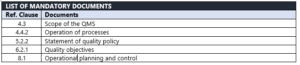
Every organization has to produce the minimum documented information required by ISO 9001 standard to demonstrate the conformance to the ISO 9001:2015 requirements. All requirements of minimum documented information listed below might not be applicable to every organization and shall be listed as an exclusion in the scope statement e.g. if an organization is not responsible for design and development, the organization is not required to produce evidence of conformance to the Clause 8.3 of ISO 9001:2015.

mandatory-documents

mandatory-records

How to determine the requirement for ISO 9001 Documentation?

Clause 7.5 of ISO 9001:2015 describes the requirements for documented information. To demonstrate the conformance to the requirements of ISO 9001:2015, an organization may need to produce more documents and records than the minimum required by the standard because according to the Clause 7.5, the organization’s quality management system shall include:

  1. documented information required by ISO 9001 (as listed above)
  2. documented information determined by the organization as being necessary for the effectiveness of the QMS e.g. policies, procedures, Instructions, Guidelines, and relevant records other than the minimum required. It is quite common that for an effective QMS, organizations establish procedures for risk management, corrective actions, control of nonconforming output, training, production, maintenance, calibration, control of documented information, and design as applicable.

The extent of documented information for a quality management system may differ from one organization to another due to:

  • the size of the organization and its type of activities, processes, products, and services
  • the complexity of processes and their interactions
  • the competence of persons

The rule of thumb for an organization is to use a risk-based approach to determine the requirement for documented information other than the minimum documented information e.g. an organization may decide that due to lack of documented procedures and work instructions, there might be a risk to product and service conformity. The organizations also establish procedures and relevant records to establish controls to address a nonconformity.

G-Certi provides ISO registration/certification services in Canada and 50 other countries for the number of ISO Standards including but limited to ISO 9001, ISO 14001, ISO 45001, ISO 27001 and ISO 22301, etc. The auditors of G-Certi ensure that your organization is conforming to the requirements of ISO 9001. Please feel free to visit gcerti.ca and contact one of our representatives for a complimentary pre-assessment to ensure that your organization is ready for ISO 9001 registration/certification.


Read more...